
- Ensure Personal Safety:
- Make sure you and your family are safe. Avoid touching or walking through the spill.
- Assess the Spill:
- Quickly check the size of the spill and if it poses any immediate danger to people or property.
- Contain the Spill:
- Use remediation product such Oil Solutions Powder to prevent the spill from spreading.
- Block off any areas where the oil could seep into drains or the ground.
- Notify and Get Help if Needed:
- If the spill is large or you’re unsure how to handle it, contact a professional cleanup service or local authorities for assistance.
- Cleanup:
- Wear gloves and protective clothing.
- Use absorbent materials such as OS Powder to soak up the oil.
- Dispose of used materials.
- Prevent Future Spills:
- Regularly inspect and maintain oil tanks by using a Tank Pan to contain any leaks or prevent future incidents.
Hydrocarbons are a group of organic compounds made up of carbon and hydrogen. Though they may be distilled from other compounds, they are generally extracted from the subsoil in the form of petroleum (liquid), condensates and liquids from natural gas (liquid by condensation), natural gas (gaseous), and methane hydrates (solids). Our economy is slowly decarbonizing. It is still primarily dependent on hydrocarbons and other fossil fuels such as coal (which is a mineral). In the form of fuel, hydrocarbons continue to be the main engine of human activities. Unfortunately, extracting and using it pollutes the soil, the atmosphere, and the oceans.
Hydrocarbons can be especially unstable; especially in hot, dry environments, they can spontaneously combust or burn easily. Many of them are also toxic and carry other carcinogens. That’s why handling hydrocarbons requires high safety conditions. The infrastructure needed for its transportation and handling is designed based on these specificities.
Our products combat an array of oils including gas, diesel, hydraulic fluids, motor oil, heating oil, condensate, transmission fluids, crude oil, jet fuel, cutting fluids, kerosene, and power steering fluids, on nearly any surface imaginable: asphalt, concrete, pavers, sand, wood, metal, rock, soil, stone, and water.
Start by estimating the size of the spill. If there are puddles of oil, apply an equal amount of OS Powder to size of the spill.
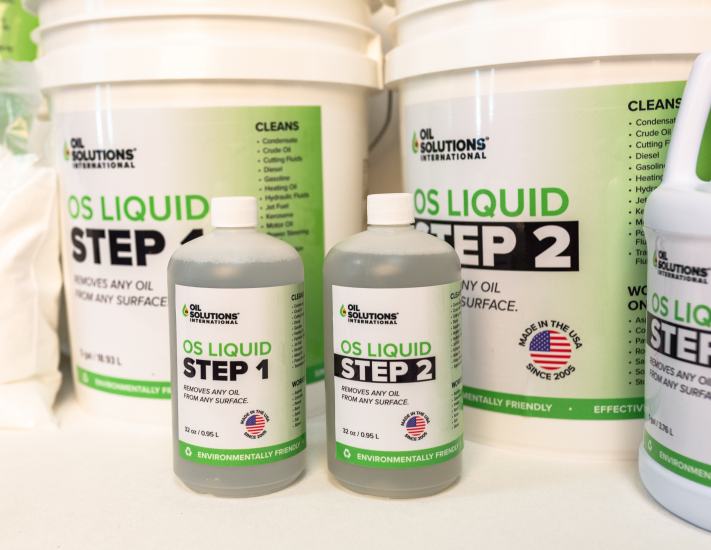
If you want to remediate a stain, apply OS Step 1 and Step 2 in a 1-1 ratio to the volume of stain.
OS Step 1 reacts almost instantly upon contact with a hydrocarbon spill, rendering the spill clear and eliminating any odor. Step 2, applied one minute after Step 1, is used as a curing agent.
Once Step 2 is applied, the spill becomes fully encapsulated within the silica material, rendering it non-dissolvable. Allowing the area to dry will yield a white powder. Occasionally, after cleaning, you may notice a white residue which will fade over time.
After ensuring that Step 1 has made contact with as much of the spilled contaminant as possible, no more than one minute is required to wait to apply Step 2.
Yes! Oil Solutions products react within seconds when applied to an oil spill.
If there’s still an odor after application, it means Step 1 did not come into contact with all of the spill contaminants. Clean up the residue from the first attempt if any remains, and repeat the process until the smell is gone.
The powder produced by OS Step 1/Step 2 is safe to leave on site. The solid residue is non-leachable and non-toxic.
If you have already waited 24 hours for the product to dry, and the result is a thick, wax-like substance instead of a powder, the incorrect ratio of the product to the spill may have been used. This does not mean that the spill has not been cleaned. Even though it’s a bit thicker to clean up, it still has all the safe, non-toxic qualities of the dried powder.
A white haze specifically occurs especially after cleaning a spill on porous surfaces. This white haze will fade over time. Alternatively, to expedite this process, agitate the area thoroughly with a stiff brush. If cleaning a larger area, consider using a hose or power washer.
OS Powder can be stored in any convenient location. OS Step 1/Step 2, however, will freeze at approximately 32 degrees F. If frozen and thawed, the product will continue to work as expected.
OS Liquid can be poured directly from the container and then spread using a broom or mop. Alternatively, it can be poured into a watering can to cover a larger area. For extensive spills on grass, soil, or walls, a pressurized pump sprayer is recommended to ensure complete coverage. A hand-pressurized pump ranging from 1 to 5 gallons, is suitable for covering large areas effectively.